Connecting Client Insights to Action
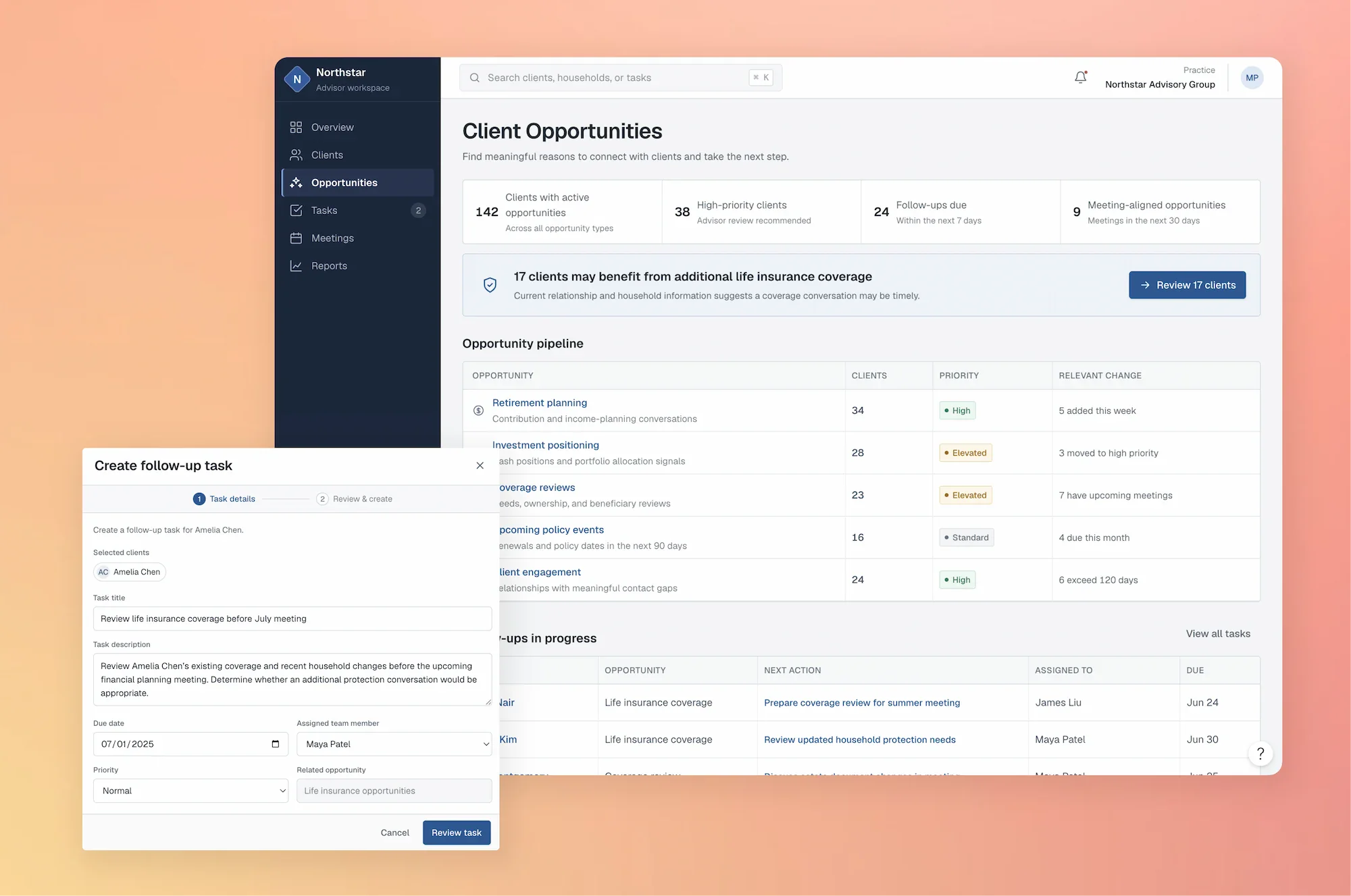
Led the design of a new experience for Northwestern Mutual’s advisor platform, helping financial advisors identify client opportunities, evaluate recommendations, and take action.
The challenge
Making it easier to know where to focus
Financial advisors manage relationships with hundreds, sometimes thousands, of clients. Keeping track of who needs attention, where opportunities exist, and what to do next is a significant part of running their businesses.
At Northwestern Mutual, much of that work happened across disconnected tools. Advisors relied on client lists, reports, CRM systems, and spreadsheets to piece together a picture of their book of business. Meanwhile, valuable information about potential client needs was available through predictive models and other internal systems, but wasn’t always easy to find or act on.
Even the term Book Management meant different things to different people. Depending on who you asked, it could refer to managing client relationships, tracking business performance, finding sales opportunities, or planning outreach.
Rather than trying to fit all of those activities into a single definition, we started by understanding what advisors were actually trying to accomplish.
Understanding the work
More information wasn’t the answer
Our research revealed that advisors weren’t simply looking for a better way to see their clients. They were trying to decide where to spend their time.
They wanted to identify meaningful opportunities, understand which clients were involved, and determine whether an action made sense. From there, they needed to coordinate outreach, create tasks, and keep track of what happened.
Much of this required moving between systems or maintaining their own spreadsheets. In foundational interviews, nearly all 11 participants used Excel for some part of Book Management, often because it gave them more control over how information was combined and organized.
In a study exploring different design concepts for identifying client opportunities, participants preferred having relevant opportunities surfaced for them over building everything from scratch using combinations of filters. But they still wanted the flexibility to investigate and refine those recommendations.
Notably, all seven participants responded positively to algorithmic recommendations, but said understanding the data that fed those algorithms was imperative. That tension became important to our approach: the system could help advisors identify opportunities, but it couldn’t replace their knowledge of the client.
Finding a pattern we could build around
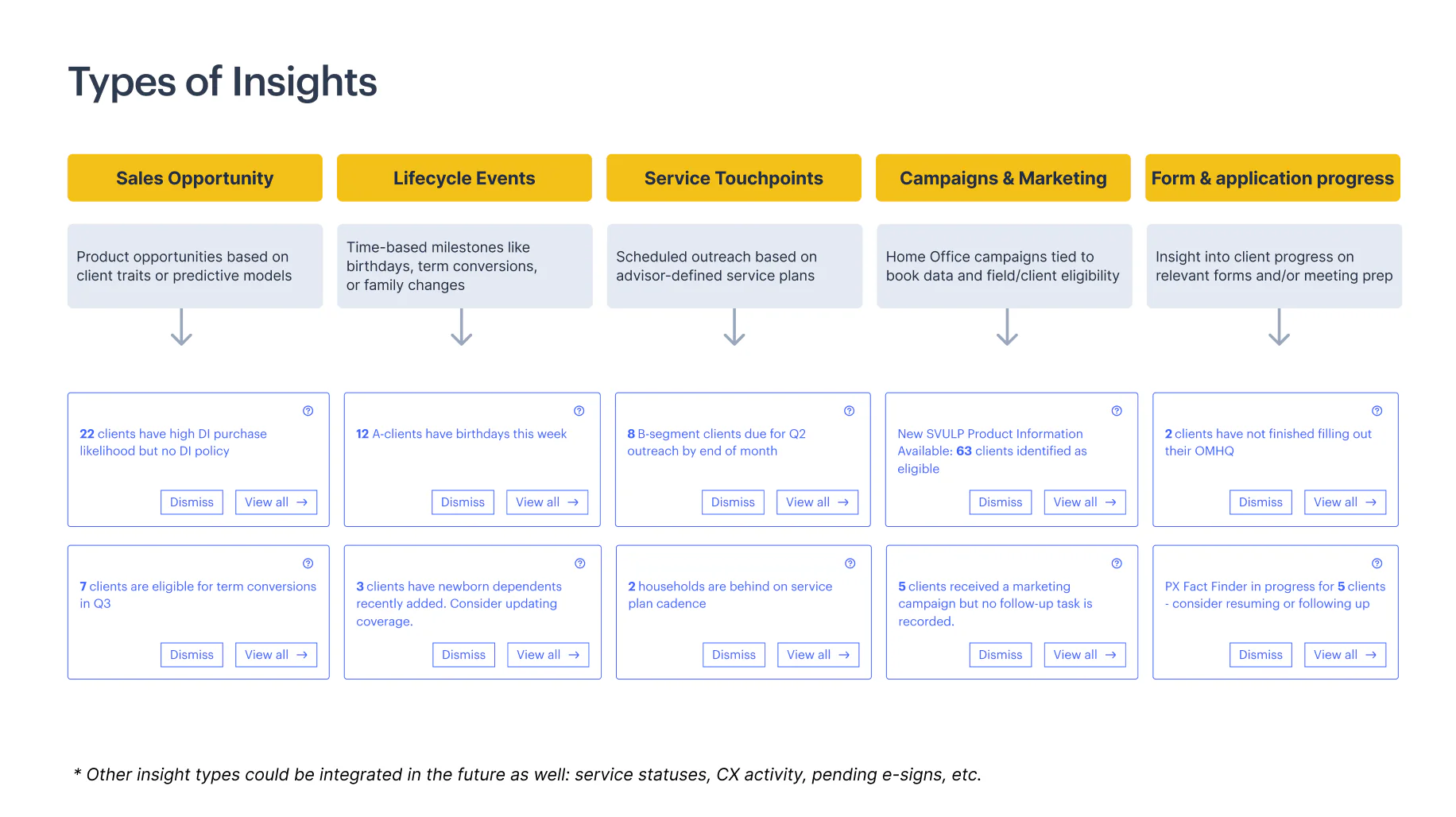
At the same time, several teams were exploring related ideas: predictive purchase opportunities, marketing campaigns, client segmentation, and recurring service plans.
Each had its own requirements, but I saw a common interaction underneath them. Something identifies a reason to engage with a client. The advisor evaluates that information, determines who needs attention, and takes an appropriate action.
Signal Insight Clients Action
A signal might come from a predictive model, an upcoming policy event, or an advisor-defined service plan. The source could change, but the underlying workflow remained largely the same.
This gave us a way to connect the initiatives without designing a separate experience for every type of opportunity. It also helped establish a clearer direction for my team. Christine, one of the designers I led, focused on the Book Insights experience and the client-list interactions that supported it. Allison, another designer, explored how automatic Outreach Plans could help advisors establish recurring engagement strategies and eventually contribute to the same experience.
My role was to establish the overall approach, guide the interaction design, and make sure the individual features worked as parts of a coherent product. We also partnered with Data Science to better understand the propensity models and their limitations, and worked with User Research to continuously test directions with advisors and their teams.
Designing the path from insight to action
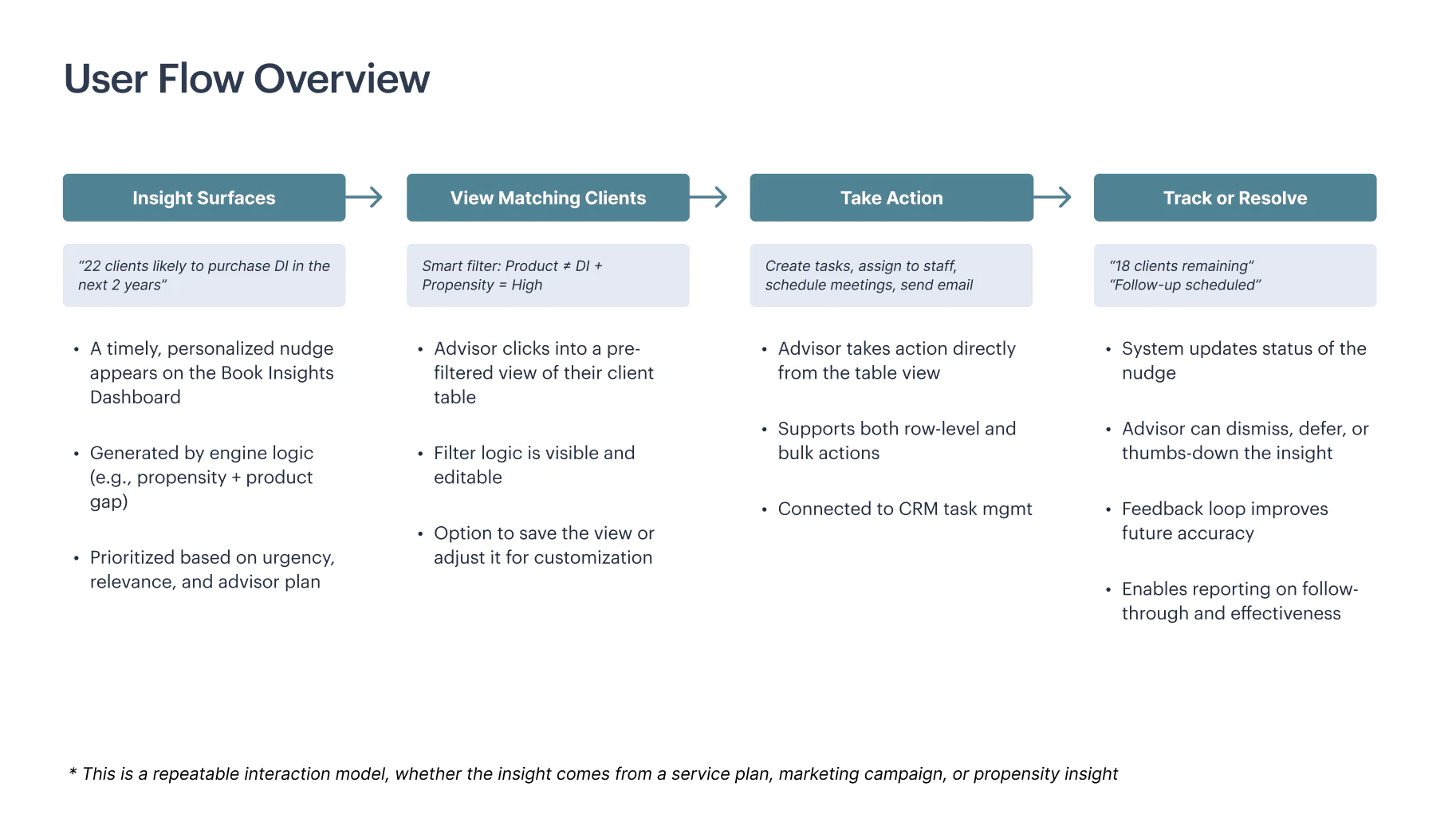
We wanted to make it easier for advisors to move from recognizing an opportunity to doing something useful with it. That meant thinking beyond the dashboard itself.
Start with opportunities, not another list to search
Advisors already had access to plenty of client data. What they lacked was an easy way to recognize which information deserved their attention.
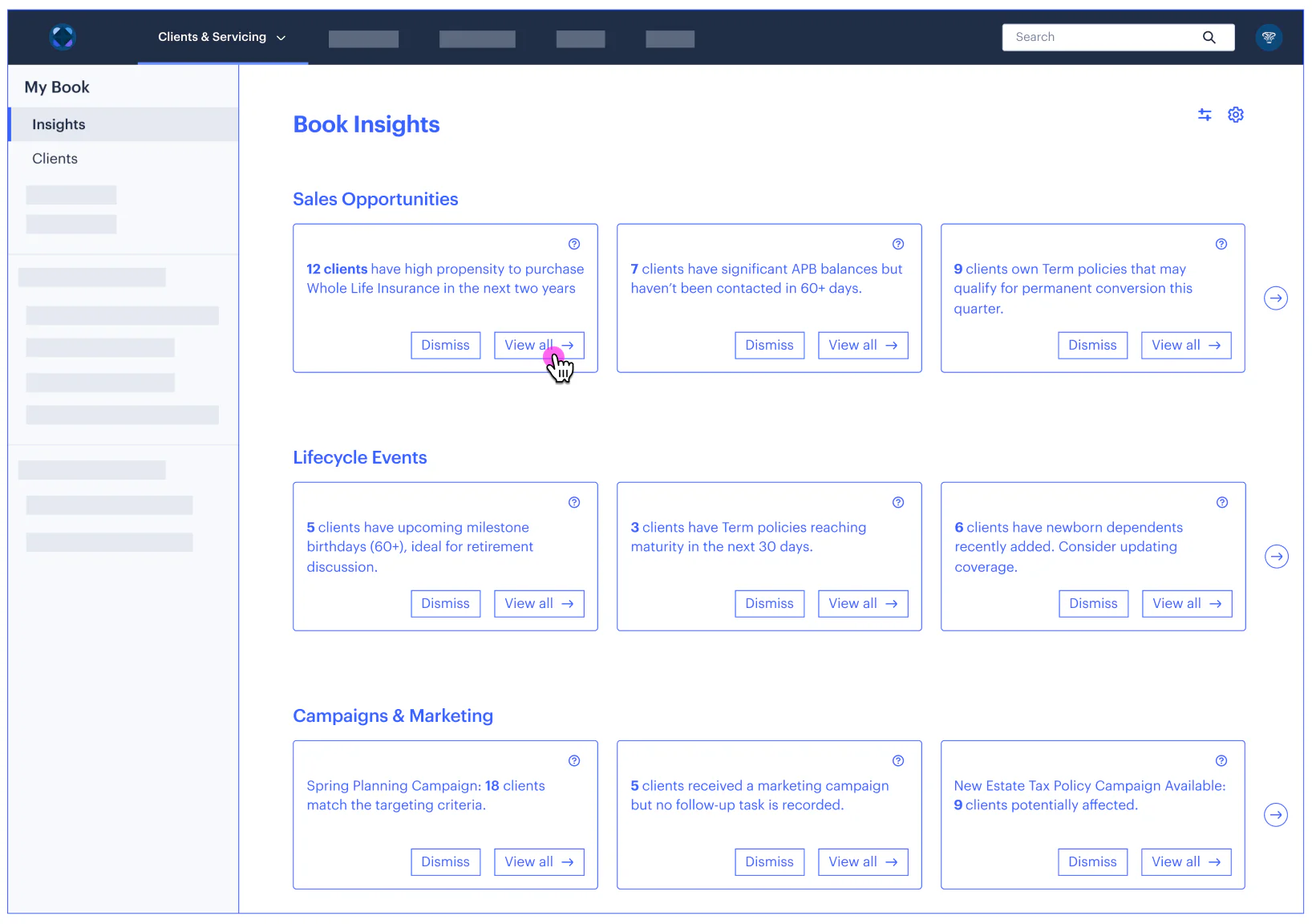
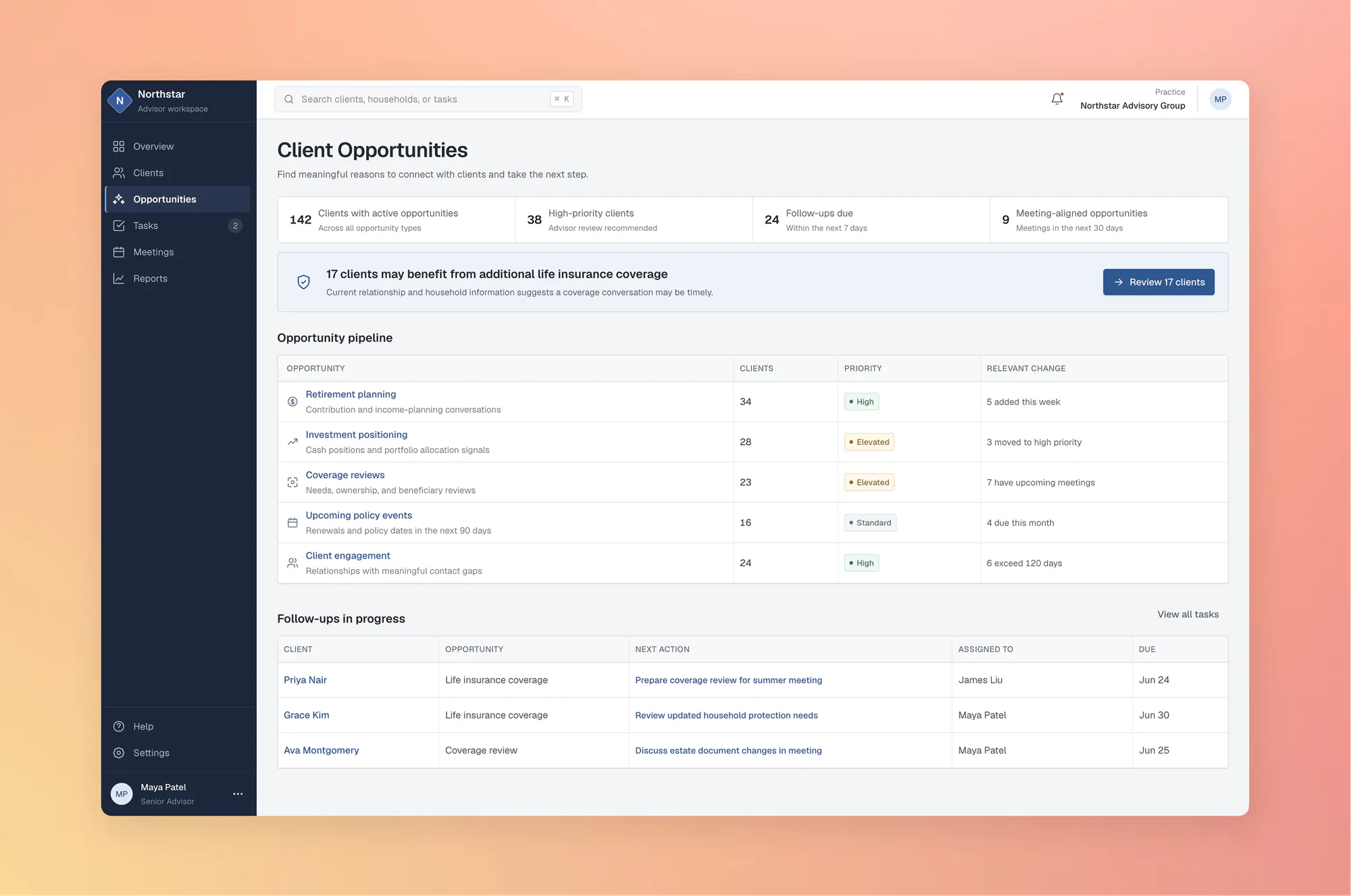
We designed Book Insights to surface opportunities proactively, including clients with a high likelihood of purchasing certain products and opportunities to deepen existing relationships.
Rather than asking advisors to construct every possible combination of filters, the dashboard provides meaningful starting points.
This direction was reinforced by research comparing two approaches to opportunity discovery. Participants favored the version with predefined opportunity categories, which made it easier to understand where to begin.
Give advisors room to apply their judgment
A recommendation is only useful if an advisor can understand what it means for the clients involved.
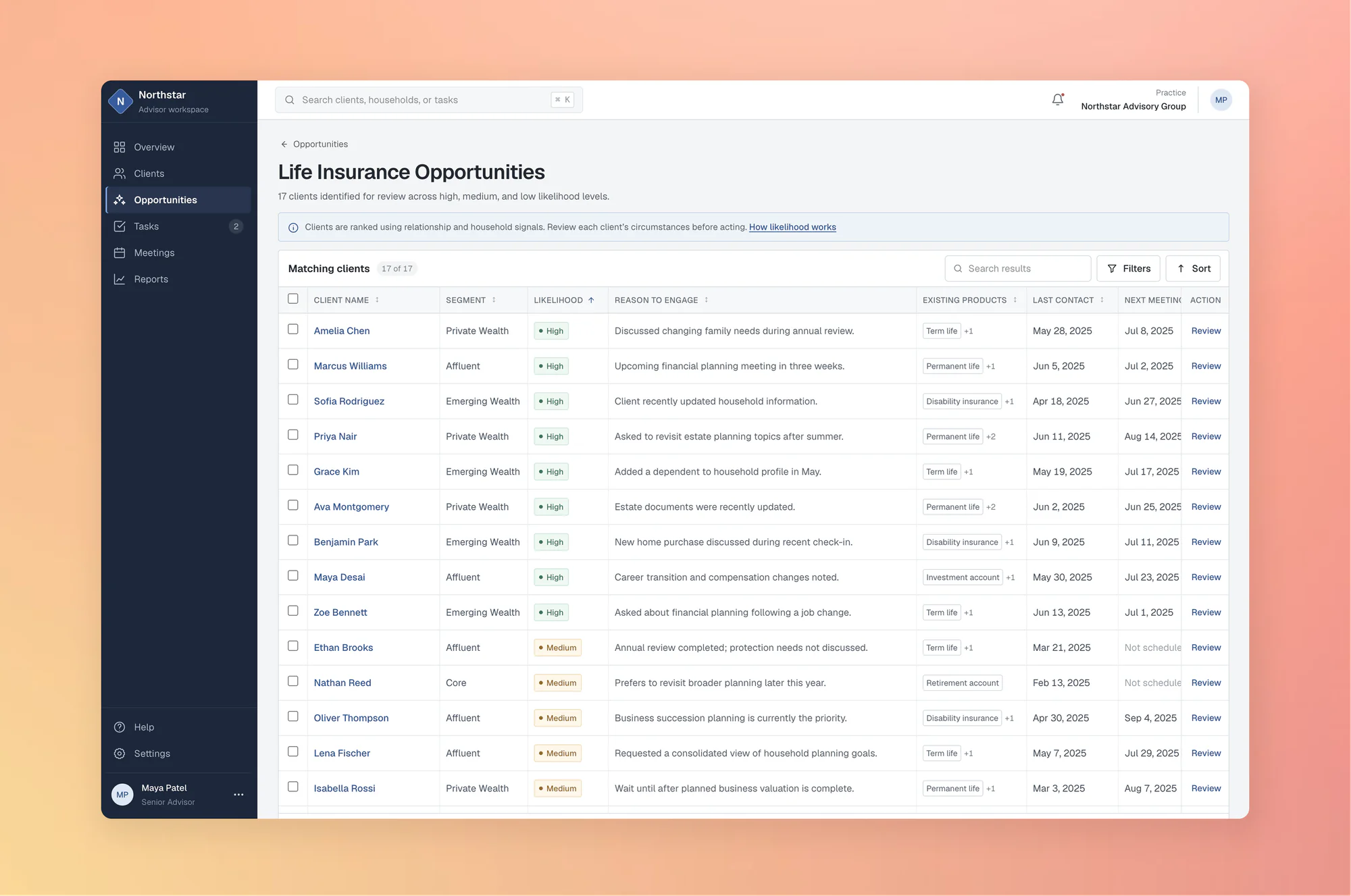
For example, the dashboard might identify 17 clients with a high propensity to purchase a particular product. But an advisor may already know that some of those clients recently discussed the product, have different priorities, or aren’t appropriate candidates for outreach.
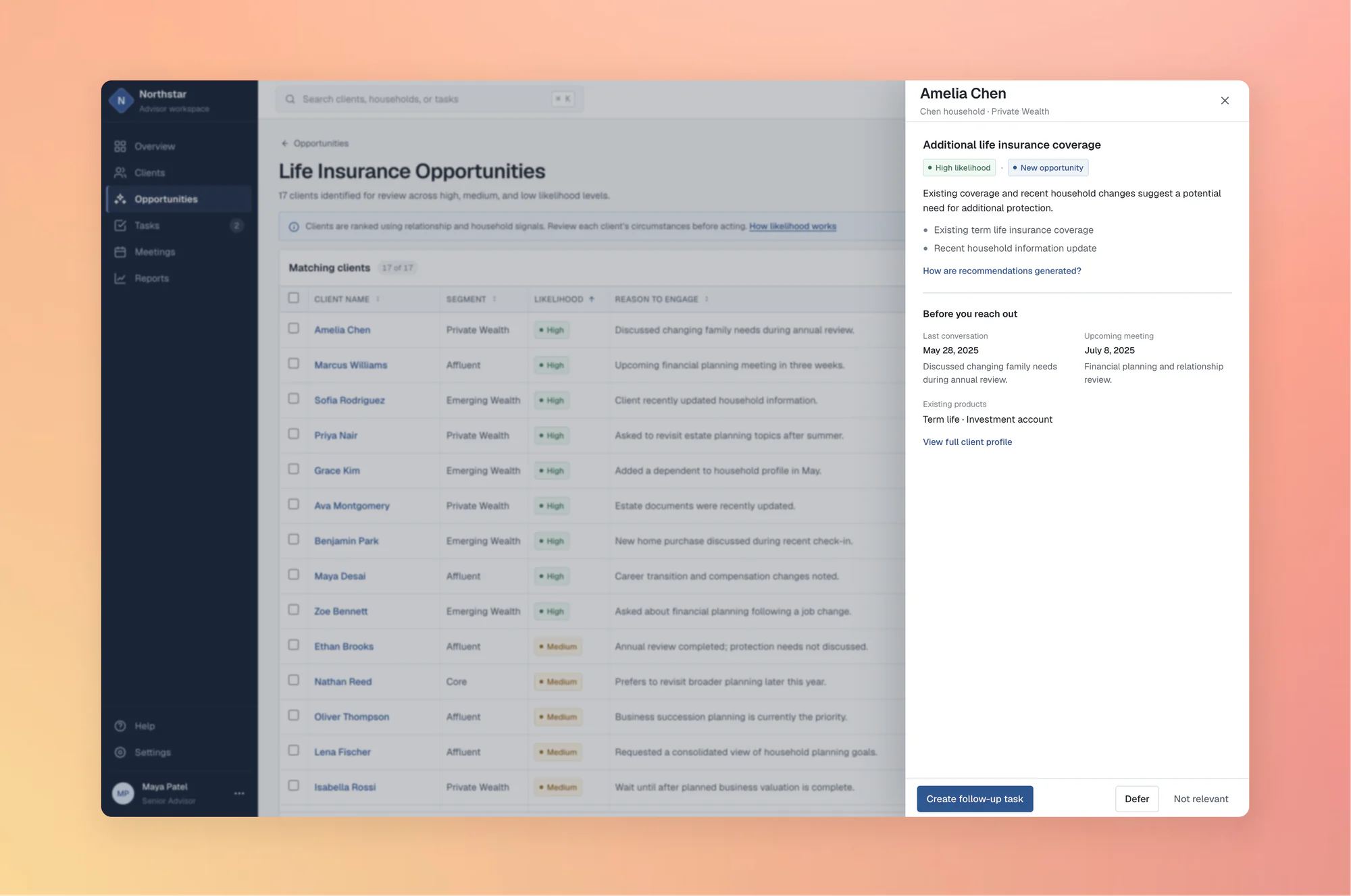
We connected each opportunity to a relevant, filtered client list so advisors could investigate the recommendation before deciding what to do.
This was an important distinction. We weren’t trying to automate the advisor’s decision. We were trying to make that decision easier to reach.
Working with Data Science also helped us understand what the predictive model could and couldn’t tell us. That mattered when deciding how to present likelihood information without suggesting more certainty than the underlying data supported.
Make the next step feel like part of the same experience
Finding the right clients was only part of the problem.
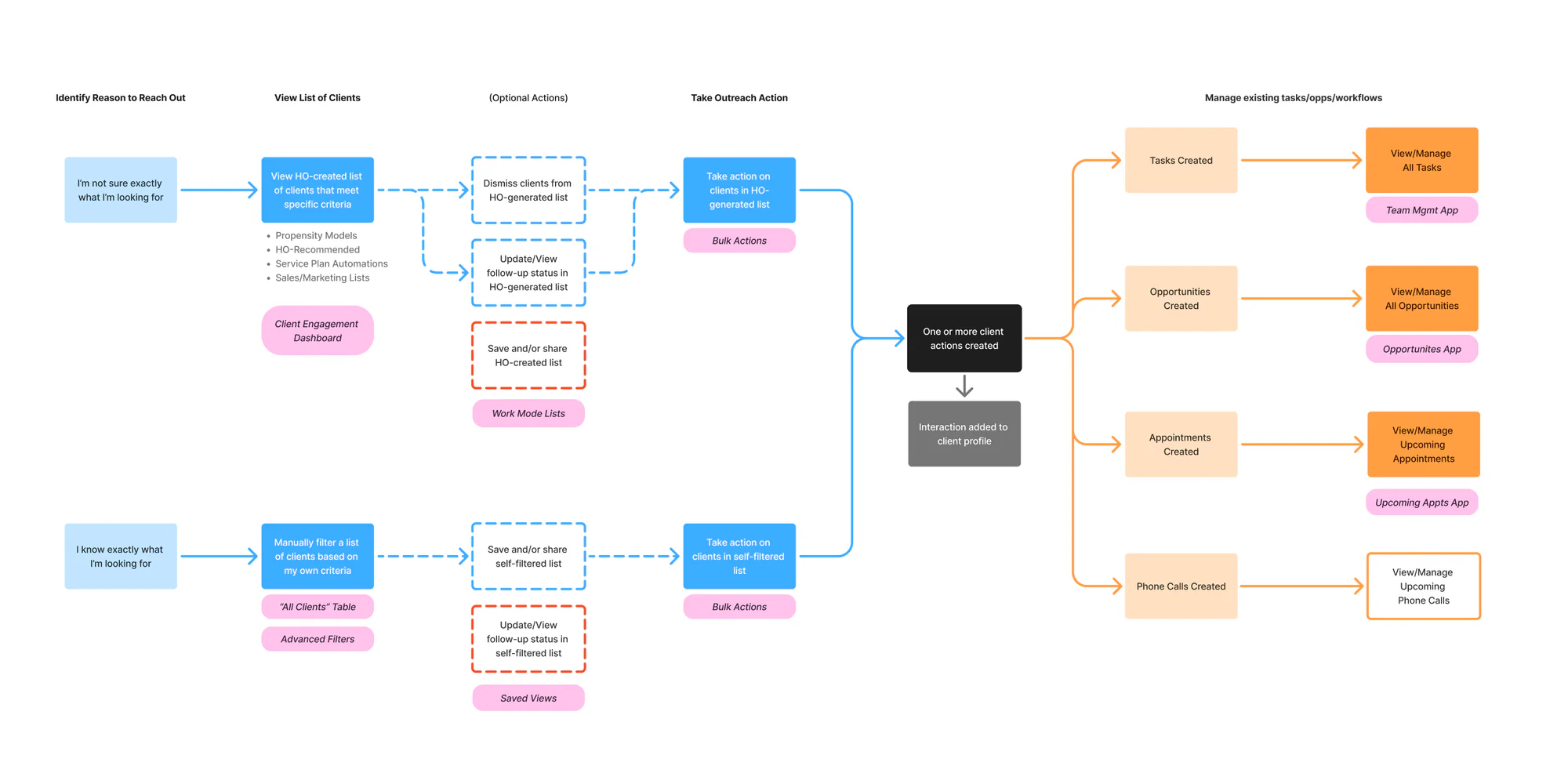
Research showed that advisors and their teams often generated a list in one place, refined it somewhere else, and then moved into another workflow to initiate outreach. We wanted to reduce that separation.
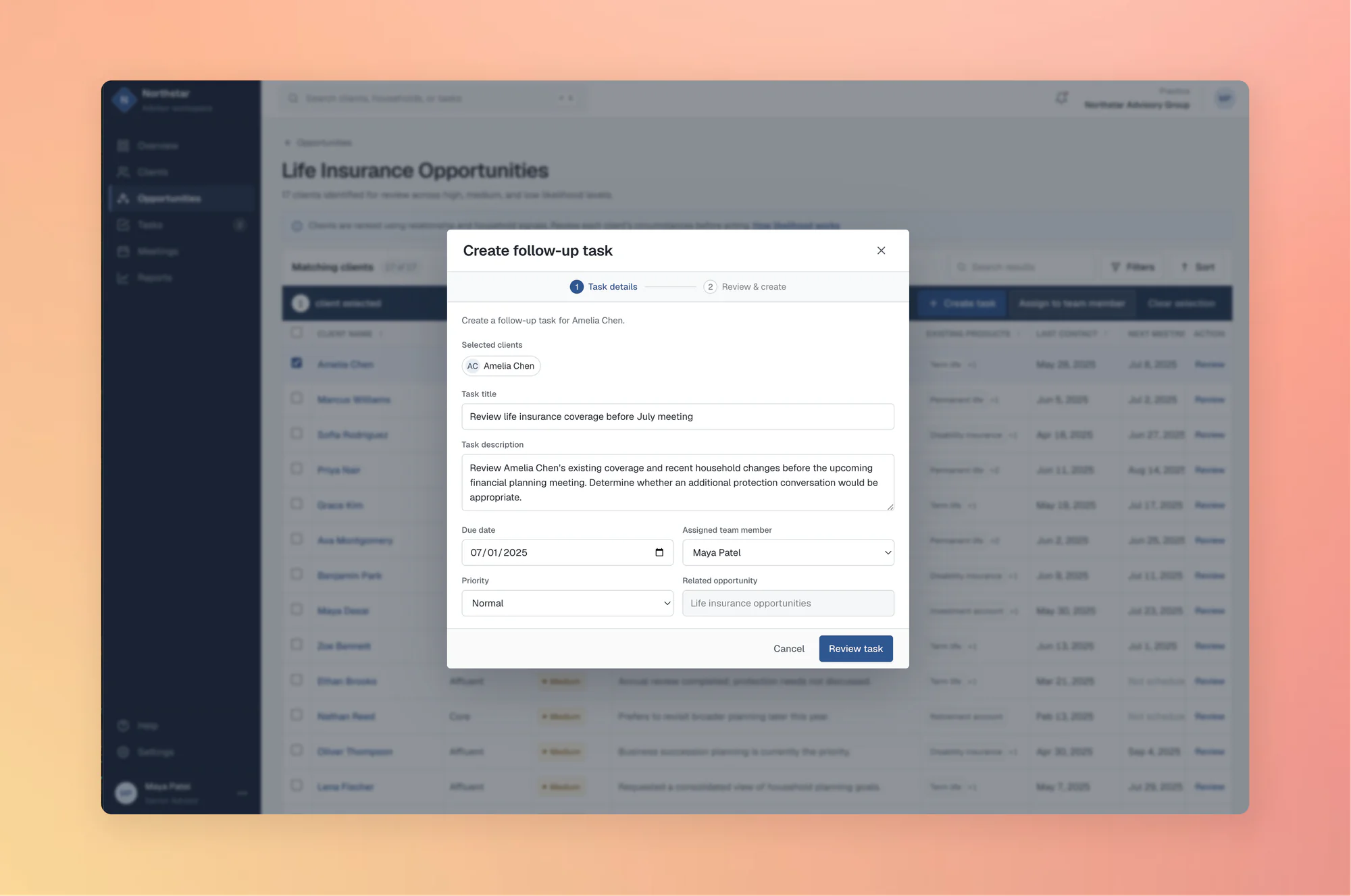
From the relevant client list, advisors could move into existing task and follow-up workflows rather than starting over in a different part of the platform.
Keeping those capabilities connected was important. We weren’t introducing a new way to manage every aspect of client engagement. We were making it easier to begin work using the tools advisors already knew.
Together, these interactions created a more complete experience: discover an opportunity, understand the clients involved, and take action.
From concept to product
The team delivered Book Insights as a new experience within Advisor Desktop, bringing predictive recommendations, product opportunities, and suggested next actions into one place.
Before launch, we tested the dashboard with advisors and team members. The experience received a System Usability Scale score of 77.1, placing it around the 80th percentile, with an average satisfaction rating of 8.7 out of 10.
Those results came from a small usability study of six participants, but they gave us encouraging evidence that the experience was understandable and useful.
The launch also gave us a foundation for future work. Rather than building a new destination for every initiative, other teams could contribute opportunities to a shared experience.
Marketing and Sales Enablement are already planning to bring additional client-engagement opportunities into Book Insights. The Service Plans experience we designed remains on the roadmap, with delivery currently planned for 2027. The underlying pattern gives us a way to extend the product while keeping the experience familiar.
What we learned after launch
The response from advisors who used Book Insights was encouraging, and we saw usage increase. But we also learned that creating a useful experience wasn’t enough to ensure people would discover it.
The dashboard was relatively difficult to find within the existing navigation. Initial communication also relied heavily on a temporary announcement, which meant advisors who missed or dismissed it had limited opportunities to learn about the new capability.
Subsequent research reinforced that discoverability remained a challenge, even among people who had visited related parts of Advisor Desktop.
We’re continuing to work through how to make the experience more visible and help advisors understand where it fits into their day-to-day work.
For me, the project reinforced two things.
- The most useful design direction often comes from recognizing a common need across problems that initially appear unrelated. Finding that pattern helped us bring several initiatives together around one experience.
- Introducing a new product means introducing a new behavior. We had designed a better way to move from client insight to action, but helping advisors discover and adopt that way of working needed just as much attention as the interactions themselves.